
At Least Social Security Will Go Bankrupt With Good Customer Service
At Least Social Security Will Go Bankrupt With Good Customer Service
Notes From the Field By James Hickman (Simon Black) August 18, 2025
I know it’s cliche, but one of the happiest days of my life was a bit more than four years ago when my daughter was born in Cancún, Mexico. My wife and I chose Mexico deliberately— given all the COVID craziness that was going on (especially in the US), we wanted to be in a place where the pandemic wasn’t going to factor into our lives at all. And Cancun was perfect.
Add in world-class healthcare at affordable prices, and it was an easy call. Plus babies born in Mexico automatically become citizens, and both parents and grandparents receive permanent residency.
At Least Social Security Will Go Bankrupt With Good Customer Service
Notes From the Field By James Hickman (Simon Black) August 18, 2025
I know it’s cliche, but one of the happiest days of my life was a bit more than four years ago when my daughter was born in Cancún, Mexico. My wife and I chose Mexico deliberately— given all the COVID craziness that was going on (especially in the US), we wanted to be in a place where the pandemic wasn’t going to factor into our lives at all. And Cancun was perfect.
Add in world-class healthcare at affordable prices, and it was an easy call. Plus babies born in Mexico automatically become citizens, and both parents and grandparents receive permanent residency.
Pretty much everything about her birth went really smoothly. The Mexican paperwork was shockingly easy, and we were able to get her passport and our residency cards very quickly.
The most difficult part by far was the US side.
We couldn’t fly back to Puerto Rico until she had a US passport. But thanks to the State Department’s broken online system (which crashes constantly and conjures bizarre errors) we were scrambling for a slot.
(It’s also bizarre that, despite millions of Americans traveling to Cancun each year, the US government put its consulate 4 1/2 hours away in Merida... not exactly convenient.)
Once there, storm-trooper style security treated a newborn’s bottled milk as a threat, and then we sat for more than an hour while bureaucrats invented reasons to say “no” to her passport application.
In the end, we finally got what we needed—but the whole process revealed the deeper truth: in the US, government offices act as if citizens work for them. They’ve forgotten their purpose is to serve, and citizens are left with inefficient, indifferent, even borderline inhumane experiences.
Some other countries take a different approach; they treat citizens like valued customers, and bureaucrats are measured on the efficiency and quality of their service.
When the US first launched the Department of Government Efficiency—DOGE—I thought this should be a critical piece of the reform.
Yes, of course, slash fraud, waste, and abuse. But even more urgently, reset the entire culture of how the US government does business with its citizens.
I recently found a glimmer of hope that this may be happening.
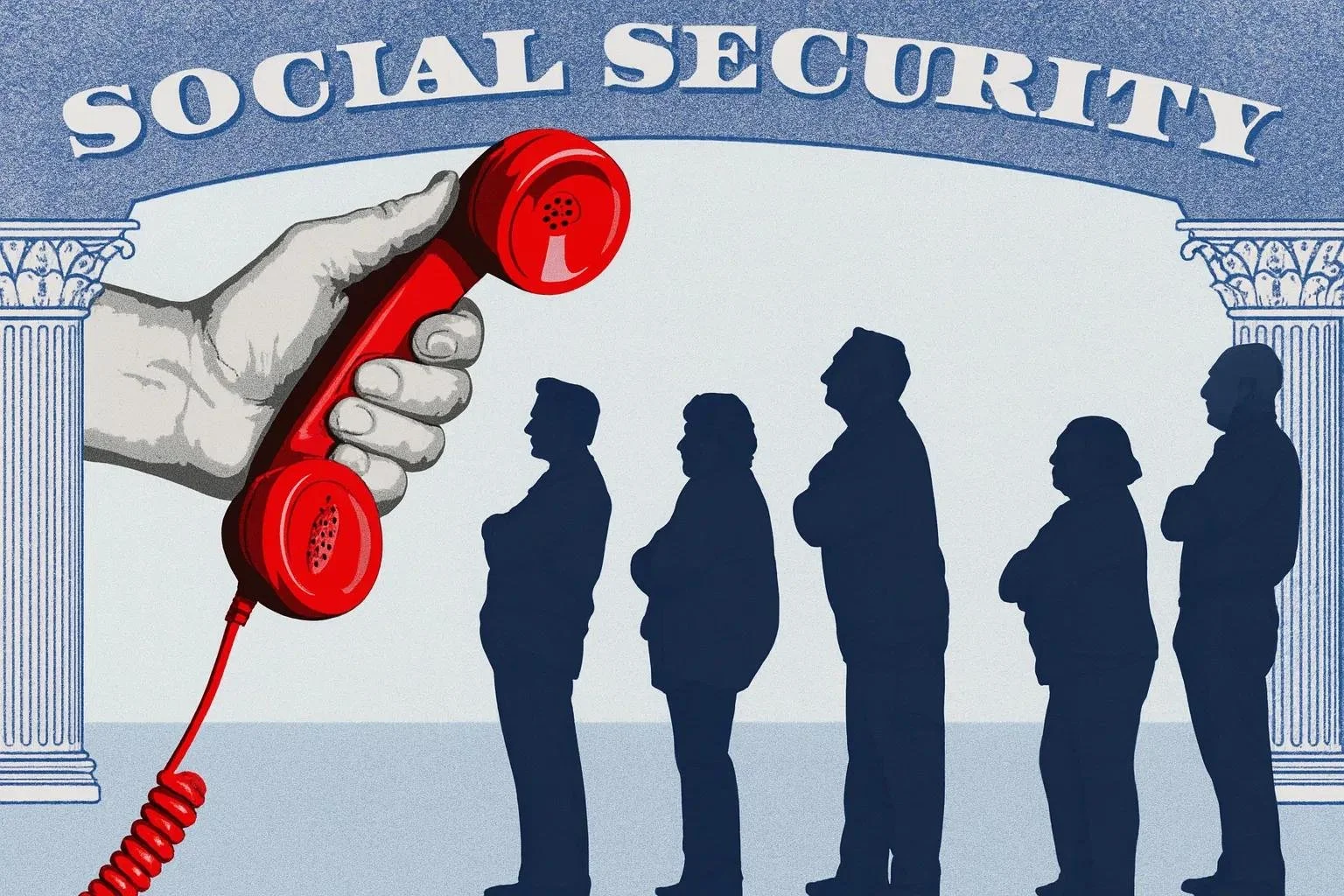
Late last week, Social Security marked its 90th birthday since being signed it into law in 1935 at the height of the Great Depression.
Ever since, generations of Americans have accumulated stories of painfully navigating this massive institution— too often about waiting rooms, endless forms, and mind-numbing incompetence.
But something unusual has happened in the last few months. Frank Bisignano, the new commissioner, took over. He comes from a CEO position in the private sector, and seems to be running Social Security like a business.
He’s pushed a digital-first strategy, incorporated AI tools, and focused on simple things that most people in the private sector would take for granted.
Processing backlogs are coming down. Efficiency is up.
Barely a year ago, you had to spend nearly 30 minutes on hold when you called Social Security. Today, the agency says the wait is under five minutes—while serving nearly twice as many people.
You can also now schedule appointments before going into an office— imagine that. And the average wait time at a Social Security office has also been slashed down to just six minutes.
The Social Security website has been overhauled as well, so taxpayers are able to obtain much more information and handle their service needs online. Crazy that it took until 2025 to make this happen.
Oh, and it turns out that the Social Security website— until very recently— used to be offline nearly 30 hours per WEEK for scheduled downtime. They’ve now eliminated this and MySocialSecurity is now available 24/7.
Frankly, the bar for government performance is so low that saying “the website now works” is heralded as a massive breakthrough.
But still, it’s encouraging to see what’s possible when someone with a private-sector mindset actually tries to fix things. In just a few months, one of the worst bureaucracies in Washington has shown major improvement.
Unfortunately, there’s one thing the Commissioner can’t control: Social Security’s looming insolvency.
Social Security’s finances are up to Congress, and that picture is bleak.
Social Security is almost out of money. Everyone in Washington knows it. At best, there’s less than eight years until Social Security’s major trust fund runs out of money. And it will probably take place sooner than that.
Just like fixing bad government service, fixing Social Security’s solvency is not complicated. At this point there are only a few levers to pull: either raise taxes, or roll back retirement age.
The trustees and Social Security’s own actuaries have spelled out these solutions for years, practically begging Congress to act.
They’ve also been clear— the sooner that Congress works to solve the problem, the less painful the solution will be.
If they raise payroll taxes now, the tax hike will be minor. If they wait until 2032, the increase will be brutal.
Similarly, if they pass a law today to phase in an increase to the retirement age, the change will be minor. If they wait a decade, the increase will be much more dramatic.
Yet Congress is—predictably—the least capable group on the planet when it comes to handling obvious problems.
Sure, most likely they won’t let Social Security fail. But the longer they wait, the more likely the eventual fix will simply be a multi-trillion-dollar bailout funded by “printing” money.
The national debt will continue its upward surge, taxpayers will fork over more money, and inflation will quicken.
Bisignano, Social Security’s new “CEO” commissioner, shows what is possible when government changes its posture.
Instead of the usual “F-you, take a number” attitude, Bisignano’s team worked to serve people more efficiently and respectfully. That massive cultural shift moved the needle almost instantly—wait times fell, backlogs shrank, and an agency long known for dysfunction suddenly became usable.
It shouldn’t stop there. The same mindset could be applied to bigger problems—Social Security’s solvency, immigration, debt. None of these are mysteries. The solutions already exist. It’s not rocket science. What’s required is competence and a willingness to act early, before the problems metastasize.
But that’s the catch. The most incompetent body of all—Congress—is the one charged with making those decisions.
And until voters stop sending the same clowns back to Washington, nothing changes.
These are people who can’t balance a budget, can’t read a balance sheet, and can barely string together a coherent thought—yet they’re entrusted with fixing the nation’s most critical programs.
It’s no wonder every solution comes too late, costs too much, and creates another crisis in the process.
To your freedom, James Hickman Co-Founder, Schiff Sovereign LLC
The Debt Problem Was Actually Scarier In The 90’s Here’s How They Solved It Podcast
The Debt Problem Was Actually Scarier In The 90s. Here’s How They Solved It. Podcast
Notes From the Field By James Hickman (Simon Black ) August 12, 2025
I was still just a kid as the US headed into the 1992 US Presidential election, but I remember the excitement around my home town as Ross Perot entered the race as an independent candidate.
Perot was from Dallas, where I grew up. And he was one of the first tech billionaires, long before the dot-com boom. Like Elon today, Perot knew that America was heading down a dangerous fiscal path. At the time, the US government was spending about 28% of its annual tax revenue just to pay interest on the national debt.
The Debt Problem Was Actually Scarier In The 90s. Here’s How They Solved It. Podcast
Notes From the Field By James Hickman (Simon Black ) August 12, 2025
I was still just a kid as the US headed into the 1992 US Presidential election, but I remember the excitement around my home town as Ross Perot entered the race as an independent candidate.
Perot was from Dallas, where I grew up. And he was one of the first tech billionaires, long before the dot-com boom. Like Elon today, Perot knew that America was heading down a dangerous fiscal path. At the time, the US government was spending about 28% of its annual tax revenue just to pay interest on the national debt.

It wasn't because the debt was so vast. Actually back then it was just a fraction of today's debt.
The real problem was that sky-high interest rates from the 1980s (15%+) had pushed the government's borrowing costs and annual interest bill to the moon.
So Ross Perot decided to run for President under a promise to fix the deficit.
Few people understood anything about the deficit back then. So Perot used his vast fortune to buy TV time where he would explain the problem in hour-long presentations. I remember learning things from him that I'd never even heard about before-- Treasury markets, bond yields, government accounting, mandatory spending, and more.
Perot single-handedly dragged America's deficit issue to the front page and started a national conversation; so even though Bill Clinton ultimately won the election, Perot succeeded in making deficit reduction a top priority.
It was interesting times politically. Clinton was rocked by scandals, impeached, and deeply hated by the other party... quite similar to the situation today. They didn't have social media back then, but 'talk radio' pundits raged 24/7 with the same ferocity of today's Twitter mob.
Yet even with such conflict and division, Congress and the White House managed to work it out. And over the next decade, interest costs fell from 28% of tax revenue down to 18%. And by the end of the 1990s the government was posting strong budget surpluses.
How did they do it? It wasn't rocket science or black magic. They simply took a common sense approach to spending-- they held spending increases to minimal levels, all while tax revenue soared thanks to a tech-fueled economic bonanza.
Over the ten-year period between 1991 and 2000, government expenditures only rose by 35%. Adjusted for inflation that's just 5.5% over the entire decade.
Meanwhile tax revenue nearly doubled over the same period. Poof. Problem solved. And America stormed into the 21st century with a record budget surplus, and its interest costs and national debt under control.
Could this happen today? Maybe. There are a lot of similarities. The US government currently pays roughly 22% of tax revenue just to cover the annual interest bill on the national debt, and this amount is growing rapidly. Not to mention, interest costs plus mandatory entitlements (like Social Security and Medicare) already consume 100% of tax revenue.
If they don't solve this problem, America is going to be looking at a major fiscal crisis in the coming years.
Unfortunately few people in power seem to be taking this seriously. The White House is far more focused on tariffs and trade rather than the obvious problem-- excessive spending. And when it comes to deficit reduction, their approach is to seize control of the Fed to push through interest rate cuts.
Congress, meanwhile, seems completely oblivious to the problem.
One of my major concerns is that American voters tend to oscillate from one side to another. So if the guys in power now don't solve this problem now, voters could swing hard to the Left in 2028, quite possibly to a card-carrying socialist.
There are certainly a lot of socialists emerging in American politics. And they all see deficits as a "revenue problem" and believe that higher taxes will fix every challenge.
Well, we did the math in today's podcast: "taxing the rich" won't make a dent in the deficit problem. Neither will wealth taxes, or any of the other idiotic proposals that socialists come up with.
The only way to fix this is to cut spending... and to spend the money much more responsibly.
Fingers crossed that they see the light. And soon. But I wouldn't hold my breath just yet on major fiscal reform... which is why it's so critical to have a Plan B.
Listen in to today's podcast, in which we cover:
The 70% tax rate fantasy – Even taxing every dollar over $10 million at 70% doesn’t cover a single year’s interest on the debt.
Why huge new taxes barely move the needle – A wealth tax might grab $200–250B upfront, then $60–100B/year. Yet the debt is growing by trillions annually.
Behavior matters – People restructure income, delay gains, and move capital. The socialists' 'wealth tax' projections will never match reality.
Their entire philosophy is to treat the private sector like an ATM while refusing to cut a cent of waste.
The problem with the socialists who want to "seize the means of production" is that they've never produced anything!
The spending problem – The top 2% already paid ~$1 trillion in taxes in 2021 (28% effective rate on $3.5T income).
Since July 4th, the US has added nearly $800 billion to the debt— about $500B of it brand-new spending.
The real “third side” of the coin – It’s not just a revenue problem or a spending problem—it’s decades of baked-in waste, fraud, and mismanagement in federal budgets.
Zero-base budgeting: A common-sense approach where agencies start at zero and justify every dollar… something almost no one in Washington is willing to consider.
Bond market reality check – The Fed can nudge short-term rates, but long-term rates are set by the bond market—
This means that political control of the Fed may not deliver the rate cuts they expect.
Socialist footholds in major cities – from NYC to Chicago to Seattle, socialists are winning local races and pushing radical tax-and-spend agendas.
The bottom line:
Confiscating more from the productive economy doesn’t fix the problem; it fuels it. The only real solution starts with cutting waste and ending the government’s addiction to spending.
Until that happens, individuals need their own Plan B—whether it’s hedging against inflation with real assets, diversifying internationally, or building networks with like-minded people who see what’s coming.
That’s exactly why we built our Total Access community. Over the years, it’s become more than just an exclusive group—it’s sparked friendships, partnerships, and a global network of people who are prepared, connected, and two steps ahead. After 15+ years in this business, it’s the thing I’m most proud of.
Listen to the full breakdown here.
For the audio-only version, check out our online post here.
Finally, you can find the podcast transcript for your convenience, here.
To your freedom James Hickman Co-Founder, Schiff Sovereign LLC
37 Trillion Reasons To Have A Plan B
37 Trillion Reasons To Have A Plan B
Notes From the Field By James Hickman (Simon Black) August 11, 2025
On Friday afternoon last week, the US national debt hit another ignominious milestone: $37 trillion. And there’s absolutely no end in sight.
Perhaps the wildest part is how quickly the debt is rising. Just before the One Big Beautiful Bill was passed on July 4th-- barely a month ago-- the national debt was ‘only’ $36.2 trillion. So, the debt increased a whopping $800 billion in a mere 36 days.
37 Trillion Reasons To Have A Plan B
Notes From the Field By James Hickman (Simon Black) August 11, 2025
On Friday afternoon last week, the US national debt hit another ignominious milestone: $37 trillion. And there’s absolutely no end in sight.
Perhaps the wildest part is how quickly the debt is rising. Just before the One Big Beautiful Bill was passed on July 4th-- barely a month ago-- the national debt was ‘only’ $36.2 trillion. So, the debt increased a whopping $800 billion in a mere 36 days.
To be fair, about $300 billion worth of that amount was ‘pent up’ debt that couldn’t be reflected on the national balance sheet until they increased the debt ceiling last month.
But there’s still roughly half a trillion dollars in fresh spending that went out the door over a five-week period. That is an insane pace of outflows.
The other big problem, of course, is that the debt is becoming a lot more expensive-- in other words, the average rate of interest that the US government pays on the national debt is steadily rising.
As of July 31st, 2025, Uncle Sam is paying an average 3.352% on the entire national debt.
That sounds pretty low… until you look back a couple of years and see the average interest rate was just 1.5% in early 2022.
This means that interest rates have doubled in just 2 1/2 years. Combined with the rapid increase in the national debt, America’s annual interest bill is quickly spiraling out of control.
Back in Fiscal Year 2021, the US government spent around 13% of its tax revenue to pay interest on the debt. This Fiscal year 2025, it will take around 22% of tax revenue to pay interest on the national debt.
That’s an extraordinary increase in just four years. And it’s quite likely this trend will continue, i.e. interest will eat up a larger and larger portion of the annual budget.
Why? Because the debt keeps rising… plus interest rates are MUCH higher than they were a few years ago.
Think about it: over the next twelve months alone, nearly $9 trillion of US government debt will mature; that’s nearly 25% of the entire US national debt maturing over the next YEAR.
Obviously, the government doesn’t have $9 trillion lying around to repay this debt. So instead, they’ll simply issue new debt (i.e. government bonds) to repay the old debt.
The key problem is that the new bonds they’ll have to issue will carry a significantly higher interest rate than the old bonds from a few years ago. And this will continue to push up the government’s average interest rate.
Our analysis-- with a lot of help from Grok-- is that it will take more than 40% of tax revenue, just to pay interest, by the year 2033 (which happens to be the same year that Social Security’s major trust funds are set to run out of money).
So, it’s not hard to see why the White House is so adamant about bringing interest rates down… and why the President is pushing the Fed Chairman to cut rates.
The President may very well get his way. Last week, a key Fed official who was a member of their interest rate committee (called the FOMC) suddenly and inexplicably resigned. She literally quit with no explanation and with almost immediate effect.
The White House responded quickly by appointing none other than Stephen Miran to fill the post; Miran, as you are probably aware, is one of the key architects behind Trump’s entire economic agenda-- everything from the tariff bonanza to the so-called “Mar-a-Lago Accords”.
Not to mention, Miran has publicly called for a weak dollar… which is clear conflict given that one of the Federal Reserve’s key mandates is to maintain a stable currency.
I imagine it will be pretty hard for Miran to maintain a stable currency when he’s working so hard (and successfully) to weaken it.
Point is, Miran will almost certainly be a strong advocate on the Fed to dramatically lower interest rates-- and to ‘print’ money-- in order to weaken the dollar and bail out the Treasury Department.
The White House will also appoint a new Fed Chairman next year once Jerome Powell’s term expires in the spring.
It’s not a sure thing, but the Trump administration is clearly doing everything it can to take control of the Fed and steer US monetary policy towards lower rates.
If they’re successful and manage to hijack the Fed, the end result will likely be a new round of Quantitative Easing (i.e. ‘printing money’), leading to a nasty bout of inflation.
But if they’re not successful, the government’s annual interest bill will probably continue to spiral out of control, eventually leading to… a nasty bout of inflation.
This isn’t exactly controversial; in fact, throughout human history, inflation has almost always been the consequence of governments’ financial mismanagement.
The good news is that America has been in this position before. As recently as the 1990s, the US government was spending well more than 20% of tax revenue just to pay interest on the national debt.
Congress and the White House both acknowledged the problem, and they worked together to address it-- primarily by reigning in spending.
Could the same thing happen over the next decade? Of course. But at the moment there seems to be zero appetite for cooperation… or to restrain spending.
So, again, the current trajectory almost certainly leads to inflation.
Now, this doesn’t mean the world is coming to an end. Civilization as we know it is not on the brink of collapse. Future inflation is a very solvable problem. But it requires taking sensible, proactive precautions now… all part of a rational Plan B.
James Hickman Co-Founder, Schiff Sovereign LLC To your freedom,
Foreigners Own Less US Government Debt—Is That a Good Thing? [Podcast]
Foreigners Own Less US Government Debt—Is That a Good Thing? [Podcast]
Notes From the Field By James Hickman (Simon black) July 23, 2025
The US owes a LOT less money to China today than it did a few years ago. As recently as three years ago, for example, China held $1.3 trillion worth of US government bonds. Today they’re down to around $750 billion.
In other words, China’s government has decided to cut back on its US dollar Treasury holdings by more than 40% over the past three years.
Foreigners Own Less US Government Debt—Is That a Good Thing? [Podcast]
Notes From the Field By James Hickman (Simon black) July 23, 2025
The US owes a LOT less money to China today than it did a few years ago. As recently as three years ago, for example, China held $1.3 trillion worth of US government bonds. Today they’re down to around $750 billion.
In other words, China’s government has decided to cut back on its US dollar Treasury holdings by more than 40% over the past three years.
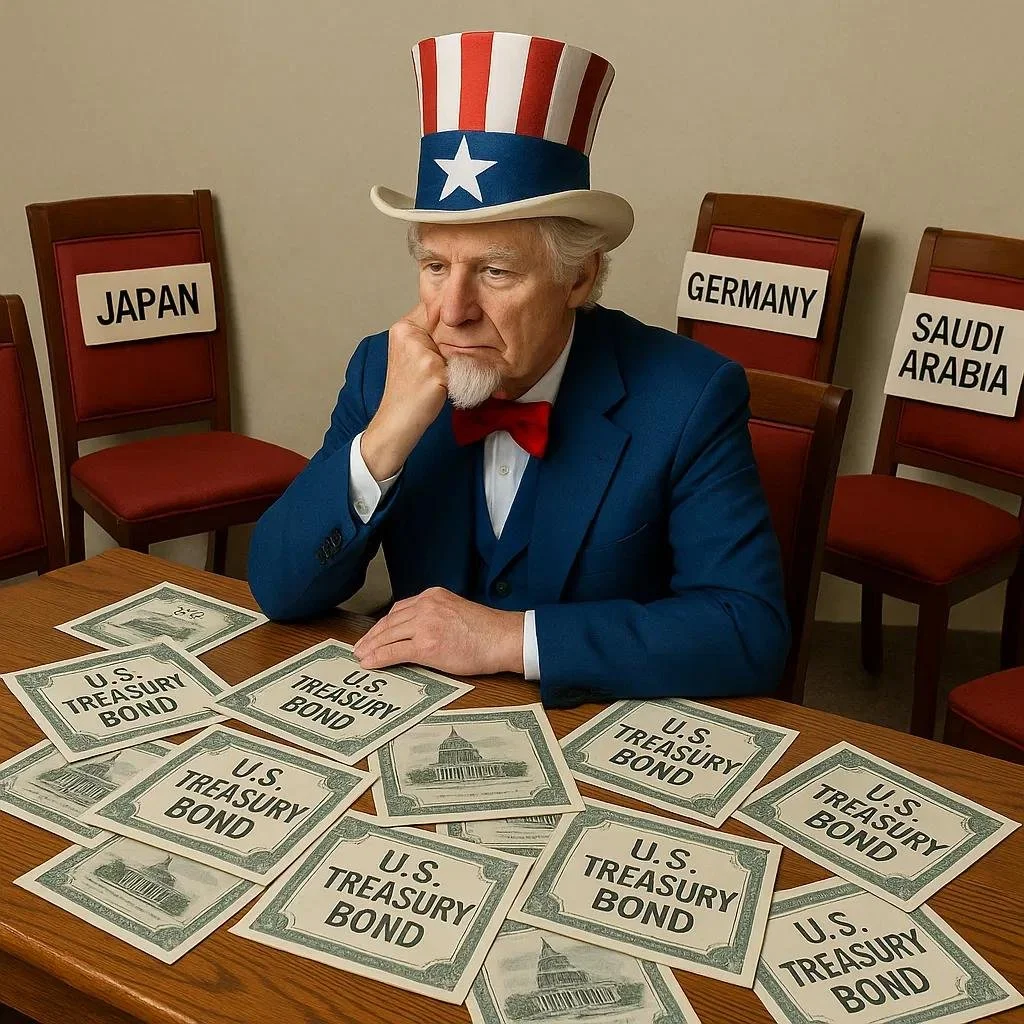
And at first, that might sound like a good thing— HOORAY! More independence from foreign creditors! America is better off without that Chinese money! Right?
But in reality this is a huge problem. Because it’s not just China.
Going back to the years before Covid, roughly a third of US debt was owned by foreigner governments and foreign central banks.
But then federal debt skyrocketed during the pandemic, and US government credibility plummeted. Even the government’s credit rating has been slashed.
As a result, foreigners across the board began stepping back from Treasury securities.
Today foreign ownership of US debt is less than 25%, and falling. This is a significant drop in just a few years.
Why it matters:
The US Treasury relies heavily on foreign capital to fund the federal government’s gargantuan (~$2 trillion) deficits. So if foreigners’ appetite to buy US government debt is waning— at a time when federal deficits are exploding higher— where will the Treasury Department come up with the money?
There are essentially two answers. Either (1) the Federal Reserve will “print” the money, or (2) domestic investors within the US economy will buy government bonds and fund the deficit.
But both of those options come at a significant cost.
Consequences of the Fed funding US government deficits:
In order for the Federal Reserve to buy US government bonds (and essentially fund the government’s annual budget deficit), the Fed must first expand the money supply.
We often refer to this as “printing money” even though it all happens electronically. The Fed calls it “quantitative easing”, or QE, but it’s all the same thing.
The consequence of QE is inflation. Serious, serious inflation.
Think about it— during the pandemic, the Fed’s QE created roughly $5 trillion in new money... resulting in 9% inflation.
Creating enough money to fund federal budget deficits over the next decade could result in the Fed having to print $15+ trillion. So most likely that’s going to be a LOT of inflation.
Consequences of the US economy funding government deficits:
American investors, i.e. banks, funds, corporate treasury departments, etc. could also buy more US government bonds in order to offset waning foreign demand.
But this capital comes at a big opportunity cost
Any private capital that goes in to the Treasury market means less money available to buy stocks, fund venture capital, or finance real estate mortgages
The net result is lower stock prices, higher mortgage rates, and slower innovation.
Why China is first to ditch US government bonds:
After sanctions on Russia, which included freezing their Treasury holdings, other countries got spooked — especially China.
China probably fears becoming the next target of US financial weaponization.
This may also be an indication that they will eventually invade Taiwan
So China is hedging: they’re selling their US government bonds and buying literal metric tons of physical gold— driving gold prices to record highs.
The bottom line:
The shrinking foreign appetite for US debt is a glaring red flag. It signals waning confidence in US fiscal credibility and could lead to a capital squeeze at home — or nasty inflation spiral if the Fed fills the gap.
Many Americans might cheer the idea of being less reliant on Chinese or other foreign money. But in reality, foreign investment in government debt is the closest thing to a ‘free lunch’ in economics.
It means that foreigners are financing federal deficits, meaning less inflation at home, and allowing private capital to invest directly in the US economy.
Losing this benefit is a bad thing for America.
You can listen to my full thoughts on the matter in this brief Podcast.
For the audio-only version, check out our online post here.
Finally, you can find the podcast transcript for your convenience, here.
To your freedom, James Hickman Co-Founder, Schiff Sovereign LLC
We Talked To One Of America’s Most Experienced Trade Negotiators
We Talked To One Of America’s Most Experienced Trade Negotiators
Notes From the Field By James Hickman (Simon Black) July 31, 2025
It wouldn’t be an overstatement to say that global trade is one of the most important issues happening in the world right now.
On April 2nd—so-called “Liberation Day”—the President upended decades of established business and trade practices that virtually every major government and corporation on the planet has relied on. All of those rules, good and bad, were thrown out the window. Overnight. And that makes this new tariff regime one of the largest worldwide disruptions to business (alongside the pandemic) since World War II.
We Talked To One Of America’s Most Experienced Trade Negotiators
Notes From the Field By James Hickman (Simon Black) July 31, 2025
It wouldn’t be an overstatement to say that global trade is one of the most important issues happening in the world right now.
On April 2nd—so-called “Liberation Day”—the President upended decades of established business and trade practices that virtually every major government and corporation on the planet has relied on. All of those rules, good and bad, were thrown out the window. Overnight. And that makes this new tariff regime one of the largest worldwide disruptions to business (alongside the pandemic) since World War II.
I’ve been wanting to learn more about this from someone who really knows what they’re talking about... someone who has real experience with international trade deals and knows the system inside out.
So last week, during a live call with our Total Access members, I interviewed one of America’s most senior and successful trade negotiators. And I learned more in that hour-long conversation about global trade than I have in decades of my own international business experience.
First things first, her experience is pretty unparalleled.
She started her career at the Office of the US Trade Representative (USTRO) during the administration of George H W Bush in the early 1990s, and throughout her career she had spent years sitting across the table from Chinese, Korean, Russian counterparts, trying to hammer out government trade deals that would be good for America.
I’ll be blunt— I came into the conversation with a really negative assumption that any career bureaucrat would be ideologically toxic. I thought that the people negotiating these deals would constantly be injecting their personal politics and fantasies... or that they wouldn’t be competent enough to make good deals for the country.
I was flat out wrong. There wasn’t even a hint of ideology. And by the end of the call I couldn’t tell who she voted for, or whether she leaned left or right. Nor did I care.
Instead, I actually felt grateful that the United States has had someone as sharp as she representing the country’s interests at the negotiating table. For her, trade deals are all business, and she’s damn good at it.
She never once implied that President Trump is wrong or naïve. But she also didn’t express unbridled enthusiasm for the administration’s vision of these trade deals either.
Instead, with a mix of extreme insight and dry humor, she gave us an incredible perspective on how the trade system actually works—and what we can expect in the coming months and years.
For example, I asked her point-blank: Is the US even in a position to demand major trade concessions?
Her answer surprised me: absolutely yes.
She explained that even though China’s consumer market is growing—and even though the Chinese government has been preparing for this moment since Trump’s first term—China is still nowhere near as valuable an import market as the US. Not even close.
Nearly every country on the planet is desperate to export its goods to the United States. And because of that, she said, Trump has tremendous bargaining power.
I even asked her about Trump’s tendency for hyperbole; he tells stories about world leaders calling him and “begging” him to drop tariffs. I always roll my eyes at such stories because they don’t sound remotely plausible.
But, again, she corrected me and said these stories are most likely true... simply because the US is in such a strong negotiating position. And there are a number of countries whose leaders would literally beg the President to drop tariffs... because steep US tariffs would send their economies off a cliff, and their politicians out of power.
Again, she’s not a rabid MAGA fanatic. She’s a seasoned, career trade negotiator who’s seen this process from every side over multiple US Presidents.
We also talked about the mechanics of how trade deals are negotiated, and the blatant mistakes that some countries (including Mexico, recently) make. She also explained how unrealistic it is to expect dozens of them to be signed in such a short timeframe.
Ordinarily, she told us, a single trade deal can take years to fully negotiate and finalize all the details. And the details can go on for hundreds of pages.
Now they want dozens of deals in a matter of weeks; these aren’t really “trade agreements”, she said, more like frameworks. In business terms, it’s like a term sheet or letter of intent.
The problem with these frameworks is that they are only a few pages and very light on details, therefore they will almost certainly leave massive gaps—ripe for abuse, noncompliance, and future disputes.
And based on that, it’s not clear whether there will be any long-term benefit from Liberation Day. There might be, but it’s not a sure thing at all.
She also confirmed what we’ve long suspected—China is better positioned to wait this out than the United States.
China has reduced reliance on US exports and doesn’t face political pressure from voters or donors. If both China and the US are damaged, she said, America is more likely to blink first.
She ended with a warning: don’t expect any clarity tomorrow (August 1, i.e. the supposed deadline for the trade deals).
Again, there might be a handful of trade ‘frameworks’, but these are just outlines. The real negotiations haven’t even started. Disputes are inevitable. Tariffs will keep switching on and off. And she expects this chaotic trade environment to last another few years.
Just a quick note that we’ll be opening enrollment to Total Access soon—our most valuable and highest tier membership at Schiff Sovereign.
We bend over backwards for our members— including setting up regular, members-only calls like the one I just wrote about with a career trade negotiator— to provide the ultimate insider access and front row seat to the world’s most important trends.
We further provide our members with private investment research and Plan B internationalization strategies (like the best and fastest ways to obtain a second passport).
Members also receive complimentary access to ALL premium content that we provide at Schiff Sovereign.
But the best thing about Total Access is building real relationships—because in today’s world, that’s what actually matters. The most valuable currency you can have isn’t dollars or gold, it’s a trusted network of like-minded people who see the world clearly and act decisively.
Our members come from all walks of life—investors, entrepreneurs, doctors, engineers, even the occasional celebrity—but they share common values. They understand that the world is changing fast. That inflation is real. That governments are out of control. And that having a Plan B is essential.
That’s why we host private dinners, organize boots-on-the-ground trips, and bring members together in extraordinary places.
Sometimes that looks like the recent trip to Turkey, where members explored opportunities in the country’s citizenship by investment program. Other times it looks more like the luxury super-yacht cruise that just concluded along the coast of Croatia.
We also host conference-style events in promising locations like El Salvador, with really interesting speakers, such as the former President of Mexico who joined our event in Mexico City.
Total Access is also how our members were able to participate in private investment opportunities like Grok, a robotics venture, and an exclusive citizenship deal directly from a European head of state.
Yes, we go to interesting places. Yes, we produce world-class research. But the real value is in the people you meet and the relationships you build.
To your freedom, James Hickman Co-Founder, Schiff Sovereign LLC
Project “Hijack the Fed” is now in full swing [Podcast]
Project “Hijack the Fed” is now in full swing [Podcast]
Notes From Te Field By James Hickman (Simon Black) July 30, 2025
To the surprise of absolutely no one today, the Federal Reserve’s Open Market Committee chose to do nothing at the close of its two-day meeting.
The White House is furious about the decision; the President believes that the Fed should be slashing rates, and that the current “high” rate of interest is costing the US government hundreds of billions of dollars each year in excess interest.
(I put “high” in quotes because interest rates are still well below historic averages...)
Project “Hijack the Fed” is now in full swing [Podcast]
Notes From Te Field By James Hickman (Simon Black) July 30, 2025
To the surprise of absolutely no one today, the Federal Reserve’s Open Market Committee chose to do nothing at the close of its two-day meeting.
The White House is furious about the decision; the President believes that the Fed should be slashing rates, and that the current “high” rate of interest is costing the US government hundreds of billions of dollars each year in excess interest.
(I put “high” in quotes because interest rates are still well below historic averages...)

Now, I am no fan of the Fed. Quite the opposite— the organization is a total failure.
Just consider that section 2A of the Federal Reserve Act (passed in 1913) states that the Fed is supposed to maintain a stable currency. Yet the US dollar has lost 97% of its purchasing power under the Fed’s stewardship over the past 112 years.
Personally I think it’s difficult to find another organization that has been so terrible at its core mission for so long.
Yet even with that scathing criticism in mind, it’s still not the Fed’s job to bail out the US government’s finances.
If Congress and the White House want to pay a lower interest rate on the national debt, then they can make the hard decisions to cut spending, balance the budget, and attract foreign investment by acting like responsible adults.
Unfortunately none of that seems to be in the cards.
So instead there seems to be a clear plan being hatched: Project “Hijack the Fed”.
Let’s start from the basics:
In order to fund its roughly $2 trillion annual budget deficit, the US government has to sell debt (bonds) to investors to plug its funding gap. And this responsibility falls to the Treasury Department.
Ordinarily, Treasury would sell a mix of US government bonds, ranging from ultra-short-term 28-day T-bills, to very long-term 30-year bonds.
Lately, however, the Treasury Department has been focused on selling mostly short-term bonds... simply because those rates are lower. The yield on a 12-month T-bill, for example, is just 3.86%, whereas the yield on 10-year Treasury is almost 5%, so it’s a difference of roughly 1%.
In some ways it’s sensible to take the lower rate. But it’s a risky strategy.
If interest rates suddenly rise, then the US government could wind up paying even MORE interest in the next few years, just to save 1% today.
So clearly the Treasury Department must have some confidence that rates won’t be going higher... and will probably be headed lower.
Last month Secretary Bessent even said this out loud: “What I’m going to do is, I’m going to go very short-term. . . Wait until this guy [Fed Chairman Jerome Powell] gets out, get the rates way down, and then go long-term.”
In other words, he’s going to keep selling the lower-interest short-term debt. Then, once Jerome Powell’s term as Fed Chairman ends next year, the Treasury Secretary thinks that HE will be able to “get the rates way down”, at which point he’ll start selling long-term debt to lock in lower rates.
This is a stunning admission that the Treasury Secretary (and by extension the White House) think that they will be able to steer interest rates much lower through their new Fed pick next year.
Coincidentally, Treasury Secretary Bessent also happens to be on Donald Trump’s shortlist to be the next Fed Chairman.
So let’s skip over the obvious legal and reputational issues involved in such a move.
The bigger problem is that there’s only one way for the Fed— even if Secretary Bessent becomes Chairman— to “get the rates way down”... and that is by expanding the money supply, i.e. what we often refer to as printing money.
And just as we saw during the pandemic when the Fed printed $5 trillion, large-scale money printing can easily lead to some nasty inflation.
Why it matters:
We’ve been talking about the next inflation cycle for a while, explaining why 2033 is the key date to keep in mind; this is when Social Security’s major trust fund will run out of money, prompting the Fed to print trillions of dollars and trigger inflation.
But given the Treasury Department and White House’s plan to hijack the Fed, it’s possible that the next inflation cycle could start up again as early as next year.
This isn’t a foregone conclusion. But it makes sense to pay close attention to what they’re doing, because it’s starting to look pretty obvious that they plan to print a lot of money starting next summer.
Today’s podcast:
I want to stress that I’m not predicting some imminent doom. The end of the world is not upon us. There is no reason for rational people to panic.
But it is becoming increasingly obvious where this trend will lead. The Treasury Secretary of the United States of America is flat-out saying that he’s going to “get the rates way down” as early as next summer. And it would be foolish to ignore the inflationary consequences of his plan.
We discuss all of this in depth in today’s podcast episode, including:
Will the next inflation cycle mean painfully higher food and fuel prices, or perhaps just an inflated stock and real estate market?
Why there’s a straight line linking the post-GFC (2010-2016) stock market bubble and ‘asset price inflation’, to the rise of Donald Trump and Bernie Sanders.
We explain that, while the Fed has a lot of influence over short-term interest rates, they can’t control long-term rates (including mortgage rates) without printing tons of money. And, yes, that means inflation.
How the next phase of money printing could make the 2020–2021 pandemic inflation look tame by comparison; it’s all about the sheer volume of money at stake, i.e. $5 trillion versus potentially $20+ trillion.
Why the US could hit a fiscal wall sooner than anyone thinks, where 100% of tax revenue is consumed JUST by debt interest, Social Security, and Medicare.
We also talk about sensible ways to position yourself for inflation in ways that make sense regardless of what happens (or doesn’t happen) next.
You can listen to today’s episode here.
For the audio-only version, check out our online post here.
Finally, you can find the podcast transcript for your convenience, here.
To your freedom, James Hickman Co-Founder, Schiff Sovereign LLC
The Root of America’s Problems [Podcast]
The Root of America’s Problems [Podcast]
Notes From the Field By James Hickman (Simon Black) July 9, 2025
In today’s podcast, we take on a provocative question from a reader: What is the single root cause behind America’s decline?
You might think it's overspending, or the Federal Reserve, or career politicians. But what if it’s something even more fundamental… like letting just anyone vote?
Should someone be allowed to vote if they don’t understand basic concepts like what a deficit is, or how the government even works?
The Root of America’s Problems [Podcast]
Notes From the Field By James Hickman (Simon Black) July 9, 2025
In today’s podcast, we take on a provocative question from a reader: What is the single root cause behind America’s decline?
You might think it's overspending, or the Federal Reserve, or career politicians. But what if it’s something even more fundamental… like letting just anyone vote?
Should someone be allowed to vote if they don’t understand basic concepts like what a deficit is, or how the government even works?
This episode digs deep into the consequences of letting uninformed masses steer the ship of state — and why it leads, predictably, to disaster.
We also address:
Term limits — and why replacing career politicians might not matter if voters keep electing clowns.
Why 2033 is the year to watch — and what happens when Social Security goes bust.
How the “One Big Beautiful Bill” may have accelerated that to ‘Crisis 2032’.
How foreign central banks are quietly ditching US Treasuries and buying gold — and what that means for the dollar.
Eisenhower’s lost wisdom — how a general who faced down Hitler and the Soviets feared inflation more than war.
Click here to listen to the full episode.
For the audio-only version, check out our online post here.
Finally, you can find the podcast transcript for your convenience, here.
To your freedom, James Hickman Co-Founder, Schiff Sovereign LLC
How A Crypto Billionaire’s Crazy Plan Could Save Social Security [Podcast]
How A Crypto Billionaire’s Crazy Plan Could Save Social Security [Podcast]
Notes From the Field By James Hickman (Simon Black) July 17, 2025
Bitcoin today is trading at around $120,000. If you’re willing to pay double the price, i.e. $240,000, please contact me immediately. I’ll happily sell you some of mine.
Why would anyone do that? I don’t know. But that’s exactly what investors are doing when they buy shares in “Strategy,” formerly known as MicroStrategy.
How A Crypto Billionaire’s Crazy Plan Could Save Social Security [Podcast]
Notes From the Field By James Hickman (Simon Black) July 17, 2025
Bitcoin today is trading at around $120,000. If you’re willing to pay double the price, i.e. $240,000, please contact me immediately. I’ll happily sell you some of mine.
Why would anyone do that? I don’t know. But that’s exactly what investors are doing when they buy shares in “Strategy,” formerly known as MicroStrategy.
The company currently holds about 580,000 Bitcoin, worth roughly $69 billion. But the market values the company at more than $124 billion. In other words, investors are paying nearly double just for the privilege of owning Bitcoin through a corporate intermediary.
Crazy, right? Yet Strategy’s Executive Chairman and co-founder Michael Saylor has managed to convince legions of investors to do just that— pay 2x the Bitcoin price.
He does so by presenting a bunch of made-up metrics to investors— terms like “Bitcoin Yield”, “Bitcoin Multiple”, “BTC $ Income”, and my personal favorite, “Bitcoin Torque”.
One of Saylor’s most clever ideas was to borrow money from investors to buy Bitcoin; the company issued billions of dollars of corporate bonds (which are supposed to be a ‘safe’ and stable asset), then used all the money to buy Bitcoin— an extremely volatile risk asset.
And this is why I think Michael Saylor should be the next Treasury Secretary— or at least be tapped to save Social Security.
I’m only half joking. Because Saylor’s idea to borrow money to buy Bitcoin might be one of the only ways to save Social Security without a serious tax hike or other financial pain.
Let me explain—
The Social Security system was built on a simple formula: workers and businesses pay taxes into the system, and those taxes fund the retirement checks to beneficiaries.
For decades, Social Security ran a surplus—more payroll tax revenue coming in than benefits going out. And that surplus was parked in a giant trust fund.
Unfortunately, though, Social Security’s trust fund was only allowed to invest in one thing: US government bonds.
The result? Pitiful returns averaging a measly 2%.
Now Social Security is running a deficit— the monthly benefits are exceeding payroll tax revenue. So the program’s administrators make up the difference by dipping into the trust fund.
The Social Security Administration officially estimates the fund will be fully depleted by 2033. And when that day comes, benefits will be automatically slashed by about 25%.
Cutting Social Security benefits would be political suicide. So the most likely solution is a major increase to the payroll tax.
But there may be another way.
What if the government were to borrow a bunch of money to start a Sovereign Wealth Fund... And that fund could invest in a diversified, real-world portfolio run by America’s many talented investment managers. Real estate. Commodities. Equities. Precious metals. Crypto. The kinds of assets that can actually grow.
This is exactly what Michael Saylor did. He borrowed heavily from the bond market to buy risk assets. Maybe the US government should do the same.
If the fund could manage, say, 9% annual returns over the past few decades— they could easily pay 6% to bond holders and pocket the extra 3%. Mathematically it works— such a return would reverse Social Security’s looming insolvency if the fund were of sufficient size.
There’s obviously risk in the plan, which is why I’m half-joking. But Social Security is in dire enough shape that all options ought to be considered.
Coincidentally, Congress is discussing setting up a Sovereign Wealth Fund this week... Though I’m not holding my breath on this, let alone any meaningful reform on Social Security.
Peter and I both believe that the inevitable outcome here is that the Federal Reserve will step in to print money and bail out both Social Security AND the Treasury Department.
In fact the White House is already identifying potential candidates to replace Fed chairman Jerome Powell when his term expires next year, as well as other members of the Fed’s board.
It’s pretty clear they want people at the Fed who will cut rates, print money, and bow to the President. So there’s a very good chance that, next year, the Fed will become much more subservient to the White House.
Such a Fed would not hesitate to engage in ‘quantitative easing’ (i.e. ‘money printing’) to the tune of trillions of dollars in order to save Social Security, or to finance massive US government deficits.
The end result will almost certainly be a major bout of inflation— probably similar to 1970s style stagflation.
It’s why we continue to assert that real assets are very sensible investments because they tend to perform so well during inflationary times.
You can hear my complete thoughts on this wild idea in today’s short video, which you can watch here.
For the audio-only version, check out our online post here.
Finally, you can find the podcast transcript for your convenience, here.
To your freedom, James Hickman Co-Founder, Schiff Sovereign LLC
Congress Looks To Hijack Crypto To Pay For Deficit Spending [Podcast]
Congress Looks To Hijack Crypto To Pay For Deficit Spending [Podcast]
Notes From the Field By James Hickman (Simon Black) July 16, 2025
It’s “Crypto Week” on Capitol Hill with all sorts of crypto legislation on the docket— including the so-called GENIUS Act that aims to regulate stablecoins. I’m not sure the GENIUS Act is in fact genius, but it might be a pretty clever given its potential benefit to the Treasury Department and government bond market.
On its surface, the bill aims to provide a formal regulatory framework for anyone who wants to issue stablecoins, i.e. digital assets that are typically pegged to the US dollar to maintain a “stable” value.
Congress Looks To Hijack Crypto To Pay For Deficit Spending [Podcast]
Notes From the Field By James Hickman (Simon Black) July 16, 2025
It’s “Crypto Week” on Capitol Hill with all sorts of crypto legislation on the docket— including the so-called GENIUS Act that aims to regulate stablecoins. I’m not sure the GENIUS Act is in fact genius, but it might be a pretty clever given its potential benefit to the Treasury Department and government bond market.
On its surface, the bill aims to provide a formal regulatory framework for anyone who wants to issue stablecoins, i.e. digital assets that are typically pegged to the US dollar to maintain a “stable” value.
But beneath the surface, the GENIUS Act is a way to funnel more money into US government bonds.
I’ve written about this many times before: the US government is hopelessly addicted to irresponsible spending. Multi-trillion-dollar deficits are no longer the exception—they’re the baseline.
And these massive deficits require the Treasury Department to borrow more money from the bond market.
Problem is that some of the biggest buyers of US government debt securities— specifically foreign governments and central banks— are starting to lose their appetite to invest more money in Treasury bonds.
So Uncle Sam is feverishly trying to drum up more lenders.
Enter the GENIUS Act— which requires stablecoins to be backed by “safe” assets, like... US government bonds!
The Treasury Department is probably hoping that some of the crypto wealth tied up in Bitcoin’s latest all time highs will flow into stablecoins... and thus into the US Treasurys backing them.
But if they think this is the silver bullet to fix America’s fiscal mess, they should think again.
Unlike traditional long-term bond buyers who help lock in funding for decades, stablecoin issuers (according to the GENIUS Act) will only be able to buy the shortest term US government debt, like 90-day T-bills.
This means that the Treasury Department will face constant pressure to refinance a major chunk of its debt every few months.
We discuss this in today’s podcast— where we also answered some reader questions about stablecoins.
One reader, for example, asked if stablecoins are a good way to diversify out of the US financial system.
My answer? Not really.
Once the GENIUS Act passes, most of these stablecoins will be issued by US-based companies and regulated by US government agencies. And over time, more and more agencies will likely encroach into the stablecoin industry— the SEC, IRS, Consumer Financial Protection Bureau, Financial Crimes Enforcement Network, etc.
That means if the government wants to restrict, freeze, or confiscate your digital dollars, they won’t even need to break a sweat. It just takes a phone call and a compliance letter.
More importantly, even if the coin maintains its 1:1 dollar peg, it’s still tied to the dollar. And if the dollar loses value due to inflation—which it is and will almost certainly continue to do—then your stablecoin will depreciate right alongside it.
Bottom line— holding a stablecoin doesn’t matter if the underlying currency is unstable. You’re not really diversifying any sovereign or currency risk.
If you're looking for real diversification—something that actually hedges against the US dollar and protects your purchasing power—stablecoins aren't the answer.
Gold, productive assets, other crypto, foreign stocks and financial accounts… those are the tools for genuine financial diversification.
If you want to hear my full thoughts on the GENIUS Act, stablecoins, and the implications to the US Treasury market, listen to this short podcast here.
For the audio-only version, check out our online post here.
Finally, you can find the podcast transcript for your convenience, here.
To your freedom, James Hickman Co-Founder, Schiff Sovereign LLC
Apple Will Pay Anything for This Crucial iPhone Metal
Apple Will Pay Anything for This Crucial iPhone Metal
Notes From the Field By James Hickman ( Simon Black) July 10, 2025
We’ve all heard the legend: there was a beautiful girl, kidnapped, a thousand ships launched, and the mightiest warriors of the ancient world descended upon the city of Troy to win her back. Obviously this was all a myth. But Troy itself existed. And the Trojan War very likely happened as well. Though not over some pretty girl.
Instead, the Trojan War likely started as a dispute over scarce resources— then quickly escalated to a full blow shooting (or stabbing/slashing) war.
Apple Will Pay Anything for This Crucial iPhone Metal
Notes From the Field By James Hickman (Simon Black) July 10, 2025
We’ve all heard the legend: there was a beautiful girl, kidnapped, a thousand ships launched, and the mightiest warriors of the ancient world descended upon the city of Troy to win her back. Obviously this was all a myth. But Troy itself existed. And the Trojan War very likely happened as well. Though not over some pretty girl.
Instead, the Trojan War likely started as a dispute over scarce resources— then quickly escalated to a full blow shooting (or stabbing/slashing) war.
And the scarce resource in question? Tin.
Back in the Bronze Age when the Trojan War was likely fought, tin was the technological linchpin of ancient civilization. Without it, there was no bronze— and thus, none of the era’s best weapons and tools.
Copper was the other half of the chemical formula, i.e. tin + copper = bronze.
The Greeks had plenty of copper mines. But the tin component was very scarce— and distant. It came all the way from Central Asia, hauled across the Black Sea, and through the narrow strait called the Dardanelles (modern day Turkey) into the Mediterranean.
And that was only if Troy— the city perched strategically at the mouth of the Dardanelles— allowed the ships to pass.
This meant that whoever controlled Troy controlled the Greeks’ access to tin. So it’s easy to see why they probably fought a war over it.
This type of resource competition is common throughout history. But it’s a lesson that has been forgotten over the past 80 years in which global trade has been open, cooperative, and free.
Today that comity is rapidly deteriorating. Given the trade wars, regional shooting wars, and increasing global tensions, access to certain resources and real assets can no longer be taken for granted.
Some of these are obvious; oil prices, for example, regularly gyrate based on the potential for supply disruptions. And despite the Left’s absurd fantasies about wind and solar, oil is going to remain critical to modern civilization for the foreseeable future.
But with nuclear energy emerging as a clear solution to provide cheap, clean energy, uranium—whose production is highly concentrated across just a handful of countries— may become a new conflict point.
Other resources are less obvious and take a little bit more digging to understand their importance in the global economy— and their scarcity.
And that includes the forgotten ancient metal tin.
Tin is the glue that holds the modern world together... almost literally.
More than 50% of all tin demand today comes from solder, which is used to connect the billions of components on electronic circuit boards. Without solder, there are no smartphones, no electric vehicles, no AI computer chips, no cloud servers, no missile guidance systems.
The more technology progresses, the more tin is needed; AI growth alone is expected to double tin demand between now and 2028.
Yet tin is an incredibly small market. Only around $12.5 billion worth was produced last year. Given that the worldwide commodities trade is more than $6+ trillion per year, the tin market is less than a rounding error. It’s minuscule.
This creates an odd situation. While tin is a critical part of the iPhone, for example, only a few cents worth goes into each unit. And this is typical across the electronics industry.
So the price of tin could increase 5x or 10x, yet the impact on Apple’s bottom line would be negligible—maybe 50 cents more per phone.
Apple would still pay for tin at 10x the price. So would every other tech manufacturer.
In other words, if tin supply tightens, buyers won’t blink… but investors will make a fortune.
And supply is tightening.
Classic tin-producing regions have gone offline or become politically unstable.
With supply tightening and demand rising, just one major Western producer is left to pick up the slack.
Production has been kept artificially low for years as Cold War strategic stockpiles were drawn down. But those stockpiles are now depleted.
There is also no substitute metal. And no feasible way to do without it.
Yet demand continues rising—steadily, predictably—year after year.
A critical metal hiding in plain sight, where even a modest supply crunch could generate enormous returns.
This compelling supply and demand dynamic is the focus of our latest issue of the 4th Pillar, our premium investment research service.
The recent July issue— published just last week— features a profitable, growing tin producer in the developed world. The company is debt-free, cash-rich, and trading at just 2.2x earnings—an insane valuation for a company producing one of the world’s most critical tech metals.
Tin is just one of many examples of the real assets that are absurdly undervalued, with extreme catalysts on the horizon.
We’ve uncovered similar stories in platinum, oil, and even iron—where supply disruptions and political pressure have created massive mispricings… and massive upside.
But some our most successful investments over the past year have come in the precious metals sector.
While central banks have been buying metric tons of gold— driving the price to all time highs— they haven’t been buying gold producers. That’s left many of the world’s best gold and silver producers trading at absurdly cheap valuations.
We’ve been writing about this for nearly two years, and the results speak for themselves:
One of our top picks is up 153% in just three months.
Another surged 146% in eleven months.
Two more have gained 133% and 51% in a matter of months.
Most others have delivered steady returns of 27–34%.
Only one has gone the other way—down 27%. But even that company is sitting on strong fundamentals and multiple catalysts— so we believe it’s just even more undervalued.
To your freedom, James Hickman Co-Founder, Schiff Sovereign LLC
Crisis 2033 Is Eight Years Away. Are You Ready?
Crisis 2033 Is Eight Years Away. Are You Ready?
Notes From the Field By James Hickman (Simon Black) July 8, 2025
US President Dwight D. Eisenhower was absolutely terrified of inflation.
And that’s really saying something for a guy who had commanded Allied forces against the Nazis, faced down the Soviet Union during the Cold War, and overseen the dawn of the Atomic Age.
Sure, those threats might seem more serious than a 5% increase in the price of milk. But Eisenhower felt strongly that inflation was a matter of national security.
Crisis 2033 Is Eight Years Away. Are You Ready?
Notes From the Field By James Hickman (Simon Black) July 8, 2025
US President Dwight D. Eisenhower was absolutely terrified of inflation.
And that’s really saying something for a guy who had commanded Allied forces against the Nazis, faced down the Soviet Union during the Cold War, and overseen the dawn of the Atomic Age.
Sure, those threats might seem more serious than a 5% increase in the price of milk. But Eisenhower felt strongly that inflation was a matter of national security.
In a speech on May 19, 1957, for example, Eisenhower told the American public that inflation “weakens the foundation of our defense. We must maintain a dollar that holds its value, for without it, our ability to sustain our military strength and support our allies would falter.”
And he wasn’t kidding. That same year the US economy fell into recession, and plenty of politicians wanted to stimulate the economy by increasing government spending.
For example, Congress passed two “make work” bills (HR 9302 and HR 7441) designed to support the economy and boost employment.
But Eisenhower was true to his word. He felt that excess government spending and deficits would invite inflation… so he vetoed both bills.
Eisenhower’s resolve turned out to be right; the US economy quickly recovered, and the recession ended in early 1958. The following year, inflation was only 0.7%.
In fact, inflation averaged just 1.4% during his entire Presidency, with strong economic growth and budget surpluses.
Things started to change in the 1960s; John F. Kennedy admitted that he knew very little about economics and even confessed that he didn’t know the difference between fiscal policy (government spending) versus monetary policy (the central bank’s control of the money supply).
Nevertheless, on June 7, 1962, President Kennedy announced his intention to pass a major tax cut.
At the time Kennedy’s proposal was highly controversial. The US economy was in good shape, inflation was low, and unemployment was low. So, the idea of passing a tax cut (which would almost certainly cause a budget deficit) was seen as reckless… even heretical.
Kennedy was assassinated before he was able to win enough votes in Congress. But his successor, Lyndon Johnson, took up the mantle and kept pushing for the tax cut.
He finally succeeded when the Revenue Act was passed in 1964.
The US economy was in great shape that year. Growth was robust, the job market was heating up, and inflation was low. So, the government deliberately running a deficit to stimulate such a strong economy was still considered bizarre and unnecessary. But they plowed ahead anyhow.
At first the US economy became a rocket ship, growing by a whopping 8.5% in 1965. Unemployment fell to just 4%. And inflation sat at just 1.9%. It was a hell of a year.
But the boom very quickly started losing steam. Federal Reserve Chairman William Martin even gave a speech suggesting that the economic boom was unsustainable and might lead to a 1929-style crash.
President Johnson was furious… and even asked his Attorney General if he could fire the Fed Chairman. He couldn’t. So, Johnson instead tried to undermine Martin in every way possible… including pushing him to cut interest rates.
Investors were aghast at the public feud between the President of the United States and the Chairman of the Federal Reserve. But things only got worse.
Johnson began demanding that Congress increase military spending to fund the war in Vietnam. Yet he also wanted more spending for his “Great Society” domestic programs-- welfare, Medicaid, federal housing assistance, etc.
Quite predictably, the US federal deficit ballooned as a result of so much spending. So did the federal bureaucracy, with dozens of new laws, thousands of new regulations, and hundreds of thousands of new federal workers.
Economic growth stalled (with GDP growth eventually falling to 0%). Inflation rose.
And investors-- already uncomfortable given the feud between the White House and the Fed-- became very pessimistic about the inflation and the deficits. So, they started demanding higher rates on US government debt to compensate for the additional risk.
Bond yields on the US government 10-year note, for example, rose from less than 4% when the Kennedy/Johnson tax cut was passed in 1964, to more than 7% at the end of the decade.
More importantly, foreign governments and central banks began losing confidence in America’s finances. The national debt was rising rapidly, and foreigners began selling (redeeming) their US dollars and holding physical gold instead.
If this story sounds familiar, it should… because the circumstances are very similar.
The US government passed its One Big Beautiful Bill on Friday, which is essentially a combination of the Kennedy/Johnson 1964 tax cut combined with Johnson’s enormous spending programs.
Granted the OBBB priorities are totally different-- like cutting Medicaid versus spending more on it. But the end result is a massive deficit spending bonanza that the US simply cannot afford.
It also comes at a time when the US economy is in reasonable shape and in no need of government stimulus. This deficit will likely invite more inflation and higher interest rates, causing an eventual recession.
The White House and the Fed are in the midst of their own public feud-- which has shocked investors.
And foreign governments and central banks have been swapping their US dollars and Treasury holdings for gold at a record pace-- pushing gold to an all-time high.
The government’s pitiful finances in the 1960s resulted in the painful stagflation of the 1970s. Unfortunately, the extreme irresponsibility of the 2020s may result in something much worse.
At least back then, the US government only spent around 10% of tax revenue to pay interest on the national debt.
Today it takes nearly a 25% of revenue. And by 2033, it could easily take 40 to 50% of tax revenue just to cover the interest bill.
2033 is crucial because that’s the year Social Security’s major trust fund will run out of money and require a multi-trillion-dollar bailout. It’s an extremely predictable crisis.
Look I’m all for tax cuts; they’re clearly linked to more robust economic growth… which the country desperately needs right now.
But tax cuts are pointless if they are not accompanied by serious spending cuts and major reform-- like overhauling immigration, fixing Social Security, and slashing federal regulations.
So, if we’re being intellectually honest, it’s important to acknowledge that this OBBB brings the country even closer to Crisis 2033. It’s eight years away, at best. Are you ready?
To your freedom, James Hickman Co-Founder, Schiff Sovereign LLC